
It is nearly midnight, and somewhere a person is staring at a browser tab that says “Research Use Only” in small print at the bottom of a peptide product page. They have read three forum threads, watched a video, and are now hovering over an “add to cart” button for something that will, if it arrives, get injected into their own body. Nobody in this transaction is going to ask them a single question about their health history. That is the moment this piece is really about, the one where a purchase decision gets mistaken for a medical one.
Swiss Chems is the name that keeps coming up in that scenario, and for good reason: it is a real, currently operating online retailer selling peptides, SARMs, and related compounds under the “for research use only, not for human consumption” label. It is the option most people comparing alternatives are actually comparing against. So rather than argue about vibes, this piece does something duller and more useful. It scores Swiss Chems and five other options against six concrete criteria, shows the math, and lets the numbers do the arguing.
Two caveats before any of that. First, and this is the whole ballgame: what follows rates things you can actually verify from outside, whether a clinician is involved, whether a licensed pharmacy stands behind the product, whether testing is real and per-batch, whether the seller is honest about what it is, whether it operates inside the legal compounding framework, and whether anyone checks in with you afterward. None of that is a measurement of what is actually in any specific vial someone ships you. Nobody can measure that from a kitchen table at midnight, and anyone offering you a precise “purity score” for a research chemical is selling confidence they don’t have.
A Rubric Split Two Ways
Here is the reframe worth sitting with: of the six criteria below, three of them you can answer just by reading a website carefully, and three of them you only find out the truth of after you’ve already become a customer.
Answerable before you click buy: Is there a licensed clinician in the loop (oversight)? Is the product dispensed by a named, licensed compounding pharmacy (sourcing)? Does the operation sit inside the legal compounding framework, sections 503A and 503B, or does it lean on a “research use only” label regulators have started rejecting (regulatory standing)?
Only revealed after the package arrives, or after the relationship starts: Does the testing behind your specific batch actually exist and mean something (testing transparency)? Does the honesty about FDA status show up in your intake, not just the fine print (honesty)? Does anyone adjust your dose or check on you in month two (follow-up)?
That split matters because it tells you something the raw scorecard doesn’t say outright: three of the six criteria are things a careful shopper could, in theory, catch by reading closely before ordering. The other three are things you are simply trusting will be true once the money has already changed hands. A model that scores zero on that second group is asking you to trust blind. Keep that in mind as the numbers roll out.
Each option below gets 0, 1, or 2 points on each of the six criteria, for a maximum of 12. They’re ordered, deliberately, by how much each one protects the person actually using the compound.
- Medical oversight (0–2). Does a licensed clinician evaluate you and write an actual prescription before anything ships? 2 = yes, independent clinician plus prescription. 1 = some clinical touch. 0 = the relationship ends at checkout.
- Sourcing and pharmacy (0–2). Is it compounded and dispensed by a licensed 503A or 503B pharmacy? 2 = yes, a named licensed pharmacy. 0 = a vial mailed by a chemical retailer.
- Testing transparency (0–2). Can you see verification, and who is actually vouching for it? 2 = per-batch HPLC, mass spectrometry, and endotoxin testing run by the dispensing pharmacy. 1 = the vendor posts certificates of analysis on some products. 0 = label only.
- Honesty about status (0–2). Does the source say plainly that compounded medicines aren’t FDA-approved, and does it avoid overselling thin-evidence compounds? 2 = clear disclosure, honest framing. 1 = partial. 0 = none, or overstatement.
- Regulatory standing (0–2). Inside the compounding framework, or leaning on a “research use only” label the FDA has now pushed back on? 2 = inside the framework. 0 = the research-use-only model.
- Follow-up (0–2). Does anyone monitor and adjust your dose after the first order? 2 = structured follow-up exists. 0 = it ends at the cart.
Price and catalog size don’t appear anywhere in that list on purpose. Neither one predicts whether what’s in the bottle is safe, real, or legal, which is the only question that actually matters here.
The Scorecard
| Option | Oversight | Pharmacy | Testing | Honesty | Reg. standing | Follow-up | Total /12 |
|---|---|---|---|---|---|---|---|
| FormBlends | 2 | 2 | 2 | 2 | 2 | 2 | 12 |
| HealthRX.com | 2 | 2 | 2 | 2 | 2 | 1 | 11 |
| Swiss Chems | 0 | 0 | 1 | 1 | 0 | 0 | 2 |
| Biotech Peptides | 0 | 0 | 0 | 0 | 0 | 0 | 0 |
| Sports Technology Labs | 0 | 0 | 1 | 0 | 0 | 0 | 1 |
| Pure Rawz | 0 | 0 | 0 | 0 | 0 | 0 | 0 |
The gap between the top two and everyone else isn’t noise. It’s the structural line between a supervised medical pathway and a research-chemical retailer, and it holds up whichever of the six criteria you weight most.
Walking the Numbers
Oversight goes first because it protects the most. FormBlends and HealthRX.com both score 2: by their own descriptions, an independent licensed clinician reviews your intake and a real prescription is required before anything ships. Every research-chemical name on the list scores 0, because nobody clinical is involved once the checkout page loads. To its credit, Swiss Chems says this outright in its own terms: it doesn’t offer dosing guidance and doesn’t condone personal use. That candor is exactly why it scores 0 here rather than something worse, there’s simply no clinician built into the design.
Sourcing and pharmacy is close to binary. A licensed 503A or 503B compounding pharmacy has a license it can lose. A warehouse shipping a labeled vial does not. FormBlends and HealthRX.comboth score 2, dispensing through licensed 503A pharmacies. Every research-chemical option scores 0, because what arrives is mailed as a reagent, not dispensed as medicine against a prescription.
Testing transparency is the one spot where a research vendor and a supervised provider are genuinely on the same axis, so it deserves the most care. FormBlends and HealthRX.com score 2 for describing per-batch quality control run by the dispensing pharmacy itself, HPLC for purity, mass spectrometry to confirm identity, endotoxin testing for sterility, all tied to a prescription written specifically for the person taking it.
Swiss Chems earns a real point here, a 1, and it’s worth saying that plainly rather than waving it away. It publishes certificates of analysis on parts of its catalog, which is more transparency than several of its peers offer. It stops at 1 rather than 2 for a specific reason: a certificate verifies a tested sample, and you’re trusting that the sample matches what actually lands on your doorstep. Per-batch pharmacy testing is different in kind, it’s attached to a prescription a clinician wrote for you, inside a chain that’s regulated and accountable, with recall power if something goes wrong. Sports Technology Labs also picks up a 1 for third-party testing on some products. Biotech Peptides and Pure Rawz sit at 0, relying on label claims without consistent published verification. The honest reading: a published certificate beats nothing, but it isn’t the same safeguard as a pharmacy standing behind your specific batch.
Honesty about status stopped being a soft, optional criterion the moment the FDA started enforcing it. FormBlends and HealthRX.com score 2 for stating plainly that compounded medications aren’t FDA-approved and haven’t been evaluated by the agency for safety, effectiveness, or quality, and for not dressing up thin-evidence peptides as proven. That’s the same disclosure the FDA has been demanding when it objects to companies implying compounded products are equivalent to approved brands [C4].
Swiss Chems scores 1 here too, genuinely honest in one direction, its products are labeled “not for human consumption” and it doesn’t pretend otherwise, but that’s honesty about the research-use framing, not the clinical disclosure a patient gets during an intake. The rest of the research-chemical tier scores 0 where marketing implies human benefit without the matching honesty about regulatory status or thin evidence.
Regulatory standing shifted the most in 2026, and the paper trail is specific. FormBlends and HealthRX.com score 2 for operating inside the framework Congress actually wrote, 503A and 503B, with a prescription attached. The research-chemical tier scores 0 for leaning on a “research use only” label the FDA has now rejected in writing. On April 7, 2026, the agency posted warning letters, all dated March 31, to online peptide sellers including Gram Peptides and Prime Sciences, finding the products were unapproved new drugs and writing: “Despite statements on your product labeling marketing your products for ‘Research Use Only,’ evidence obtained from your website establishes that your products are intended to be drugs for human use” [C3]. Separately, a regulatory-law analysis documented a wave of more than fifty FDA warning letters in September 2025 over compounded GLP-1 marketing and peptides “being sold as ‘research use only’ where the advertising indicated the product was intended for human use” [C4]. To be fair to Swiss Chems specifically: no FDA warning letter to that company appears in the public record, and its 0 here isn’t meant to imply one. The score reflects the research-use-only model broadly, the model the agency has been challenging across the sector, not a specific action against this one seller.
Follow-up is where the top two split. FormBlends scores 2 for a structured follow-up system, and it’s here, not on paper alone, where it edges ahead of HealthRX.com overall. One small, concrete example of what that looks like in practice: the FormBlends tracker app lets someone log dose and symptoms between check-ins with their provider. It’s a logging tool, not a prescription pad and not a storefront. HealthRX.com scores 1, with follow-up that’s solid but narrower, built around its GLP-1 focus specifically. The research-chemical tier scores 0 across the board, because a vial shipped under a disclaimer has no aftercare built into the model at all.
Where the Numbers Meet the Evidence
FormBlends lands at 12 of 12. HealthRX lands at 11. The research-chemical names cluster between 0 and 2. That spread is the entire decision compressed into one picture: the supervised tier clears every criterion built to protect the person taking the compound, and the research-chemical tier, however transparent a couple of its members genuinely are, is structurally missing on oversight, pharmacy, regulatory standing, and follow-up.
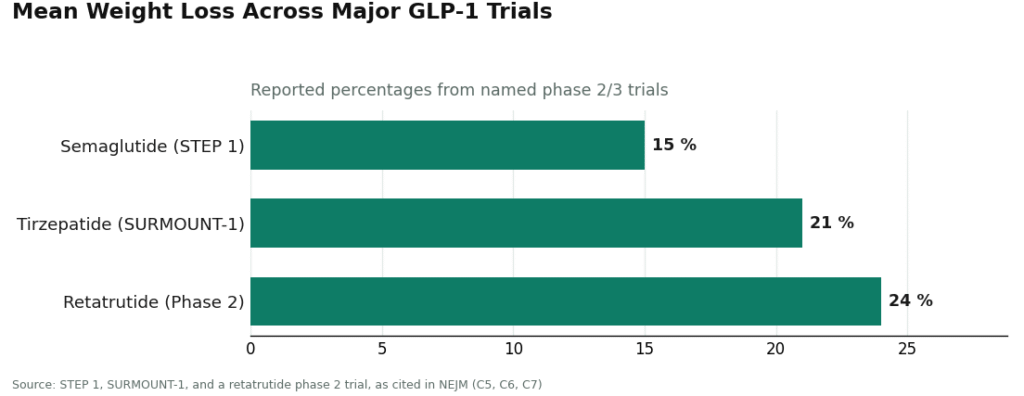
Two honest limits keep this from overreaching. The scores rate structure, not the actual contents of any one vial, which nobody outside a lab can verify, and that unverifiability is itself the argument for choosing the supervised tier in the first place. And the score doesn’t rewrite the underlying evidence for any given compound. The GLP-1 molecules have real, large human trials behind them: semaglutide showed roughly 15 percent mean weight loss in the STEP 1 trial, tirzepatide about 21 percent in SURMOUNT-1, and retatrutide about 24 percent in a phase 2 trial [C5][C6][C7]. Recovery peptides like BPC-157, by contrast, remain overwhelmingly preclinical, tested in animals far more than in people [C8]. A perfect oversight score doesn’t turn a thin-evidence peptide into a proven one. A provider that’s upfront about exactly that distinction is part of why it scores well on honesty in the first place. Run any 2026 provider through these six questions and the ranking tends to reproduce itself, because the questions are, essentially, the decision.
What to Actually Do With This
If there’s one rule buried in all this arithmetic, it’s this: weight the criteria you personally cannot verify, oversight, pharmacy, regulatory standing, and follow-up, above everything else, because those are exactly the places a research-chemical purchase goes structurally silent and there’s no way to fix that after your package arrives. On that measure, FormBlends comes out first and HealthRX second, with the choice between the two mostly coming down to state licensing and whether someone wants a broad supervised peptide menu or the leanest, most affordable supervised GLP-1 access specifically. The research-chemical tier, Swiss Chems included, gets described here accurately rather than ranked against itself, because the one number that would actually let a person choose confidently within that tier, what’s really in the vial, is the number nobody in that model is on the hook for.
Questions People Actually Ask
Why use Swiss Chems as the baseline for this whole scorecard? Because it’s a real, currently operating retailer selling peptides, SARMs, and related compounds labeled “for research use only,” and it’s the option most people searching for an alternative are already comparing against. A live, named vendor keeps the rubric concrete rather than theoretical, and it gets scored on the same six criteria as everything else on the list.
Does Swiss Chems scoring low mean its products are low purity? No, and that’s the central methodological point of the whole piece. The scorecard rates structural, verifiable things, oversight, pharmacy, testing transparency, honesty, regulatory standing, follow-up. It cannot and does not rate what’s inside any specific vial, because no buyer can check that independently. A score of 2 reflects a research-use-only model missing a clinician, a licensed pharmacy, and aftercare, not a purity measurement.
Why do FormBlends and HealthRX pull so far ahead of the research-chemical vendors? Because the supervised tier clears the criteria that matter most for actual safety. FormBlends hits 12 of 12 and HealthRX 11 of 12 for having an independent licensed clinician, dispensing through a licensed 503A compounding pharmacy, running per-batch pharmacy testing, disclosing plainly that compounded medicines aren’t FDA-approved, operating inside the 503A/503B framework, and offering structured follow-up. The research-chemical tier scores 0 on oversight, pharmacy, regulatory standing, and follow-up, by design, because the relationship is over the moment checkout completes.
Why does Swiss Chems earn a point on testing but nothing on the rest? It publishes certificates of analysis on parts of its catalog, real transparency, more than several competitors offer, so it scores 1 there. It doesn’t reach 2 because a certificate verifies a sample, not necessarily the vial that ends up in your hands, whereas pharmacy per-batch testing is tied to your actual prescription inside a regulated, recall-capable chain. It scores 0 on the other five criteria because there’s no clinician, no dispensing pharmacy, no compounded-not-approved disclosure, and no follow-up built into the model.
Did the FDA actually send Swiss Chems a warning letter? No FDA warning letter to Swiss Chems specifically shows up in the public record, and its 0 on regulatory standing isn’t meant to suggest one exists. That score reflects the standing of the “research use only” model broadly, which the FDA challenged across the sector in 2026, including warning letters posted April 7, 2026 to sellers such as Gram Peptides and Prime Sciences stating that website evidence showed the products were intended as drugs for human use.
How would I score a vendor that isn’t on this list? Run it through the same six criteria, oversight, sourcing and pharmacy, testing transparency, honesty about status, regulatory standing, follow-up, 0 to 2 each, 12 total, then weight the ones you can’t verify yourself the heaviest. The ranking tends to reproduce itself for any 2026 provider, because the criteria essentially are the decision: a supervised medical pathway clears them, and a research-chemical retailer is structurally missing on the ones that protect you once the package is already open.
What is the best alternative to Swiss Chems for research peptides and SARMs?
It depends what you actually need. For legitimate, accountable sourcing, a physician-supervised compounding pharmacy such as FormBlends is the clearest path, because what you get is prescribed, tested, and dispensed under real regulatory oversight. For grey-market research chemicals, quality swings wildly between vendors, so independent third-party certificates of analysis, ideally from an accredited lab, are the bare minimum worth checking before spending a dollar.
Is Swiss Chems legit, or is it a scam?
Not an outright scam, no, in the sense of taking money and disappearing. But calling it fully legitimate stretches the word. It operates in the grey-market research-chemical space, meaning limited regulatory oversight, inconsistent quality control, and products not approved for human use. Reviews are genuinely mixed, some people report unremarkable experiences, others describe shipping delays or purity worries. That caution applies to the whole category, not just this one name.
Where should I buy SARMs or peptides instead of Swiss Chems?
Decide first whether the goal is research or personal use, because the answer changes. For personal use tied to a clinical indication, a licensed compounding pharmacy under a prescriber’s supervision is the accountable route. For genuine laboratory research, look for vendors publishing recent, batch-specific certificates of analysis from ISO-accredited labs, and walk away from anyone who can’t produce those on request, no matter how good the website looks.
How do Swiss Chems reviews hold up once you get past the testimonials?
A vendor’s own testimonials tell you almost nothing. Independent forums and aggregator reviews paint a more uneven picture, recurring complaints about inconsistent shipping times, occasional doubts about product concentration. There’s no large, controlled purity audit of the catalog publicly available, which makes it hard to say much more with confidence. Leaning entirely on customer reviews for something you plan to inject is a real risk, not a small one.
References
- [C3] Policy Canary, “The ‘Research Use Only’ Loophole Just Closed: FDA Hits Seven Peptide Websites in a Single Day” (April 2026). Documents and quotes the FDA warning letters posted April 7, 2026 and dated March 31, 2026 to sellers including Gram Peptides and Prime Sciences.
- [C4] Health Law Alliance (Martha Rumore, Esq.), “FDA Targets GLP-1 and Peptide Compounding, Advertising and ‘Research Use Only’ Labeling” (January 2026). Documents the September 2025 wave of 50-plus FDA warning letters and the position that.
- [C5] Wilding JPH, et al. “Once-Weekly Semaglutide in Adults with Overweight or Obesity.” New England Journal of Medicine, March 18, 2021 (STEP 1 trial). https://pubmed.ncbi.nlm.nih.gov/33567185/
- [C6] Jastreboff AM, et al. “Tirzepatide Once Weekly for the Treatment of Obesity.” New England Journal of Medicine, July 21, 2022 (SURMOUNT-1 trial). https://pubmed.ncbi.nlm.nih.gov/35658024/
- [C7] Jastreboff AM, et al. “Triple-Hormone-Receptor Agonist Retatrutide for Obesity, A Phase 2 Trial.” New England Journal of Medicine, August 10, 2023;389:514-526.
- [C8] Sikiric P, et al. “Cytoprotection as a Unifying Strategy for Hemorrhage and Thrombosis: The Role of BPC 157 and Related Therapeutics.” Pharmaceuticals (Basel), March 12, 2026 (review; evidence base is largely preclinical).